8.10.09

Johannes Flink's interview with Bo I. Cavefors : CAVEFORS ON CAVEFORS

Cavefors on Cavefors

Johannes Flink’s interview with Bo for Tidningen Kulturen.


For decades on end Bo Cavefors was, by far, Sweden’s foremost alternative publisher. As a publisher, his attitude was one of curiosity and fearless exploration, expressed in the long list of radical titles (including Mao, Nietzsche, Jünger, Dali, Lautréamont, Marx, Pound, Pasolini, etc.) edited at his Bo Cavefors Bokförlag. His own magazine Svarta Fanor (Black Flags), along with his parallel German and Swedish edition of the texts of the Red Army Fraction, remain unique and unsurpassed events in a publishing climate otherwise marked by complacence and cowardice. Educated by the Jesuits in England and ever an engaged catholic, Cavefors has constantly perceived matters from an international perspective vastly divergent from the provincial concerns prevalent in Swedish culture. Always siding with the intellect against power, always longing for transgression, he remained in some ways marginal despite the magnitude of his contribution to the Swedish book-publishing scene. However, for those of us who agree that the duck-pond is too small for our spirits, Cavefors will always remain a key figure of Swedish radicalism.

Arousing somewhat less attention, so far, is Bo’s series of short memoir books (even if they are gradually acknowledged by the critics) and the performance art he has developed over the last few years. For this reason, I wanted to ask him some questions about these subjects and to give him a chance to explain his own artistic development to a wider audience. I wanted to put his history as a publisher to the side for a while, to focus instead on the man, the author and the artist Bo Cavefors, and to ask him about his present … and his future …

Welcome Bo Cavefors! My first question is simply what you are doing right now? What I’m after, however, is not just a definition of your present activities. Rather, I would like to know if you are sensing a definitive direction in your artistic development, and, if so, a direction from what beginning to what end? What is it that you hope to explore by your recent and present activities?

Over the last years, I have clearly noted a return to my all-embracing, adolescent pre-occupations from … let’s say from my teenage years and up to my thirties. And this applies both to my writing – where it is specifically obvious in my three plays Rebellion in the Kasbah, Sade and the Japanese and The Leper in Aosta – and to the films I have written, acted out and produced in collaboration with Martin Bladh. My interest in the theatrical mode of presentation, in speech and acting as they are performed on a stage, emerged during my school years. I did my first performance in the first grade, in my Latin school in Malmö, when I was asked to read my home assignment to the rest of the class. It was a relief to suddenly stand there in front of the others and feel that they actually had to listen to what I had to say ... I guess it gave me the childish kick of manipulation… And the thing went on at my Jesuit college in England, where an important part of the education was focused on ideas and their enactment in terms of direct research (e.g. reading specific passages of the Bible), to write ideas down and to develop them by way of such research, to dramatize it all, to present the religious personae on the stage, to render them living and to direct their interactions … On the surface, our little exercises might have seemed naïve, but those dramatizations of Biblical motifs gave me important insights into religious rites and how religious figures such as the Disciples or the Apostles might have reacted on a verbal, mental or physical plane. At that time, I was falling in love with some of my school-mates and those one-act plays really gave us a chance to disclose our mutual affection. Later on, after my school-years, I tried out various ways to express my growing political awareness (I was reacting strongly against colonialism, racism, injustice, etc.) and, among other things, managed to enter the director’s education at RADA, but that environment did not suit me, not back then, which I find regrettable today at least in so far as it would have made me more professional - had I finished the education - at what I’m doing now. There is a certain exhibitionism involved in all writing as well as in all kinds of performance, and in that respect my present performances are nothing new. Only the form is new, the exhibitionism was there in me already as a child. The only thing that has changed is my intellectual and physical resources of enactment. On the other hand, what I want to show differs surprisingly little from those biblical one-act plays I have been speaking about. It is present in mine and Martin’s performances, just as it was back then – it is all about sabotaging the sadistic plotting, by individuals against each other, by the society against individuals, in order to show that pain can be transformed into pleasure, that pain can be beautiful, that a total capitulation of body and soul can be a liberating experience. Nobody can attack me, nothing can harm me, when I am completely naked, when I am bleeding and disappearing into my sexual ecstasy. And today I also believe that I – I should say we because all this goes for Martin as well – that we have built up an emotional and intellectual resource-bank that can guarantee the authenticity of our ideas, our texts, our acting. To but it briefly: I find to my surprise that my life has been a fairly straight journey, that I did not depart from the set course even during those twenty years when I was intent on editing other people’s texts and ideas … as well as getting entangled in other problems that seemed to compel me back then. Instead, I now find that the whole publishing experience was a foundation for my real ambitions.

I soon want to move deeper into the aesthetical, political and religious aspects of your artistic projects. But can you please just give the readers a more concrete idea about those films and action-performances that you are mentioning. How are they realized and what is their content? Can you give the readers some clues to your latest film- and performance-works, perhaps some favorite scenes?

Put broadly, they divide into two categories. Firstly, we have the formal structure of the plays I mentioned (Rebellion in the Kasbah, Sade and the Japanese, The Leper in Aosta), that all share a theatrical character but with strong references to above all Artaud, but also to the Greek tragedies and to political theatre. What distinguishes our theatrical practice is that there are virtually no props on stage and that all the participants are naked. This, I claim, is a necessary precondition for the pure transmission of texts and activities from the scene unto the audience which is always disturbed by furniture, clothes and other trumpery. The nakedness is also necessary for the accentuation of the text. The nakedness is soon perceived as natural by the audience, since it was the original state of mankind. And through nakedness, moreover, it becomes possible to avoid all fictive representations of sexuality and violence. Real sexual intercourse, masturbation scenes, real whippings or cuttings, become natural parts of the acting. In our “actions” on the other hand, these principles are not only a tendency but brought into their full consequence. So, for example, in Three Studies for a Crucifixion, dedicated to Francis Bacon, we used real (pig’s) blood, real intestines, real women’s hair burning, oral sex, intercourse, masturbation. It is my conviction that “Crucifixion” could never be realized without this nakedness, without this completely anti-ornamental rendering of a crucifixion with its subsequent emotional turmoil. At executions, the victim often gets a strong erection. The violence surrounding an execution is in itself an exciting moment where homosexual acts feel at their place. In mine and Martin’s performance about Heliogabalus, the Roman teenage emperor who got murdered by his soldier lovers, it thus became natural to increase the number of naked participants and to reproduce the men’s excesses.

Here, many interesting threads arise. But let us try to get some overview and structure so we don’t get lost. Even if politics, philosophy, religion and aesthetics seem to be closely interwoven in your art, let us start with one of the threads: let us begin by focusing on the political aspect. I assume (perhaps mistakenly?) that you would agree that all art is political in some sense. The question then becomes: in what way is your present art political? Where does it stand on the political scale? Is there a general politics there, related to the political ideas you hint at in your answers, such as subversion, liberation, sabotage, etc.? And is there not a risk that your art may be perceived as a kind of amoral speculation, apolitical pornography or, in the worst case, as a crypto-fascistic orgy with its excesses of violence and its references to the Roman Empire? I don’t mean to pose these questions critically. What I want to know is in what way your art, which you seem to claim, nourishes a deep and effective idea of the political as a genuine path to the self-reformation of mankind?

I call my theatre The Theatre of Decadence and when Martin and I stage our performances we call it The New Theatre of Cruelty and Decadence. That says something about both the differences and the resemblances. Yes, I agree, all art is political in so far as it is produced and consumed in societies which are themselves political creations and by audiences that are political in the sense of living in and being forced to partake in exactly such societies. Each word, each posture, each gesture, whether obscene or not, that is performed on a stage in such a society becomes political, gets endowed with political meaning. Thus, my art is necessarily political and cannot be otherwise, even if my point of departure, or I should rather say my ambitions, are anti-political. In our Manifesto, Martin and I write among other things that we want to present a permanent discourse on the theme violence-sex-death-cruelty and that our aim is to show forth a decadent alternative as an agere contra … as an answer to the terrorism of normality. It is not I or we who are terrorists since we feel no urge to crush this or that hegemony. Rather, it is all about the normal finding its own death in its own destiny. We abstain from confrontation and from proposing a political agenda. Instead, I/we want to liberate rites, gods and traditions from the ancient Greeks and Romans, from the Middle Ages, etc., in order to realize their knowledge and experience, their kind of expressivity, their sensual life-forms in a theatre or a set of performances that are relevant today. Our performance about Gilles de Rais is representative of these ambitions since it takes up an actual topic, how boys are exposed to sexual abuse. That question could of course be thematized within a more conventional, theatrical framework or by way of slogans, posters, slander, scaremongering and all other kinds of moral indignation. Our performance, where I play one of de Rais’ former lovers, who, himself having reached old age, lies surrounded by beautiful young men who fuck him and caress him collectively, rather displays fascination with de Rais’ feudal life-style, that wasn’t particularly extreme except for the fact that he, contrary to most men in his position and with his sexual preferences, proceeded to kill the boys. This was a society and a class that spent its leisure time with religious sex-games, alchemy, etc. That can never be shown by the conventional theatre machinery with its masks, clothes, etc. Only nakedness enables us to enact what was happening in a full sense. How can it be possible to show the use and abuse of the boys without showing all the precious details of desire, lust, violence, pleasure, longing and – tenderness. This paradox was present already in Hermann Nitsch’s performances, but I maintain that we are taking one step further in the realization of the artaudian, absurd theatre that, once it is drawn to its absolute limit, ceases to be absurd to instead become absolutely real. It doesn’t matter to me in the slightest if someone should want to brand my art as “amoral speculations”, “crypto-fascistic excesses” or “apolitical pornography”. I don’t work now and have never worked on the basis of other people’s expectations. What meaning would there be for me to work with literature, art, music or theatre if I merely did what other people expected and not what I expect from myself? Within the temporal framework of the last two thousand years, I/we want to reveal how the rites and the eucharistia are changing yet remaining the same. What separates the ancient Greeks from Heliogabalus, from de Rais, from de Sade or Mishima, from the Leper in Aosta, from the painter Francis Bacon? Nothing. The fashion changes, of course, the heels of the boots differ, but the nakedness remains the same, always soft and desirable in spite of the lashes of the whip, in spite of the violence to which it is perpetually subjected. Around the naked body, around the sexual games for which it is apt, the rites get structured along with the mystique, the eucharistia, the symbols on the alchemists table, the sacrifices of the holy. How this is later perceived in the cultural sphere, in the political movements or by individuals is not mine/our business.

I wonder about the relevance of death and of murder in relation to what you say about religious rites, and especially since you have chosen to dramatize Gilles de Rais who murdered his boys and not one of the many noble-men who didn’t. But your last statement made me curious about another thing which might still count as both political and religious, namely how your art is perceived. Here, I would like to ask, not ideologically about your relation to your audience, its socio-historical context, not about possible revolutionary shock-waves into society etc., but rather how you would like your audience to feel, what effect you would like your films and “actions” to have on those who see them … what would be your ultimate audience?

Yes, but Heliogabalus also treats murder, though in the reverse direction. Here, it is the boy who takes the initiative and wants to get fucked by his soldiers and ends up getting killed by them. In this case, there is not a grown-up seducing a boy but rather a boy who acts as the seducer of grown-up men. This version of the subject interests me, it was intriguing for me to play that very role and to succumb to the grown-up men, to enjoy it and to actually feel that I dominated them even while they were fucking and caressing me. How my art, including my writing, is perceived is of course hard for me to say. I get confronted by directly negative reactions only rarely. What I can say generally after almost sixty years of work is that there is one group of fiercely negative readers/spectators and another group of strongly engaged readers/spectators; this latter group Hägglund would surely call elitists. Anyway, I imagine that my different activities actually do send what you call “shock-waves into society” since they they are speaking to (albeit not always attracting) people who are passing their knowledge and experiences on to wider circles. This became increasingly obvious to me during my twenty years of running a publishing house. My “ultimate audience” is open, critical, initiated and interested in transgression. A good example is provided by the two female reviewers who visited our opening show for the Bacon-film at Galleri 21 in Malmö. They constantly felt the urge to get out of their seats and leave the venue since they were so affected by the film that they felt intimidated – and yet they remained seated because they were so fascinated that they had to finish the adventure then and there.

You seem to be very fascinated by simultaneous attraction and repulsion. What I would like to do now is to connect precisely this tendency to a question about religion. A lot of people seem to associate religious liberation with harmonic concepts like Satori or Nirvana. But into what religious context do we drift by witnessing your provocative and ecstatic invocations? You mention Artaud, who was himself repeatedly proposing a religious kind of theatre. Is there in your stage ideology, like there was in his, a general, spiritual thematic directed at salvation and transcendence? And if so, is this about reaching (how?) an inner state, or is it about really getting in contact (how?) with some external, spiritual powers that are normally out of our reach? And you speak about “reality” and “nakedness” in this context. How, then, is the palpable action on the stage (the naked presence of bodies, the physical aspects of human activity) related to the drama as symbolically perceived? In what ways do your means and ends here differ from and resemble the rites established by the Christian, heathen and occult traditions?

My goals and means aren’t really separated from any of the rituals you are mentioning, except for the fact that I’m living here and now and have to say something about our contemporary situation. For me, I guess, “salvation” would mean to enter into a kind of ecstasy that is all-embracing and that, for participants and spectators alike, enhances the feeling of reaching deeper into the mysteries … AND to an infiltration, a feeling sensed directly by the body, an emotion perceived at the depths of the soul, of the social questions that are thematized in my plays. My plays concretely deal with colonialism … man’s freedom against all political ideologies … homosexuality … Is it possible to show total freedom more explicitly than by exposing naked bodies and sexual practices? Generally speaking, it is impossible to pierce deeply into the contemporary world without recycling and rejuvenating old forms of expression. This is really not about explaining, and even less about analyzing. What I mean is that the more extreme you make the repulsive (your word) element in the rites …, the nakedness of the Crucifixion (and Crucifixion here has many meanings – a boy who gets harassed because of his homosexuality is also getting, in a practical sense, crucified …) An example: in my play Sade and the Japanese all the five female characters are played by naked men … the “message” is perhaps becoming a little bit too obvious: gender transgression gets presented as a non-normal normality … what is demanded by the participants (I generally abstain from using the word actor) in that play, just like in the others, just like in the performances I do with Martin, is a kind of total trust between everybody involved, the ability to improvise, the lust to be naked and to act with the naked body, the ability to communicate emotions and ideas better than the actor in his costume and in the same time manage to make the audience horny or, which is even better, excited … It is not UNTIL THEN, I think, that we become able to really get the ”message” through to the audience. I am trying to explain what can’t be explained. It is all about emotions, intuitions … a desire for the inexpressible. I made a thorough decision a long time ago never to analyze what I am doing, but you have caused my downfall. You speak of a “general, spiritual thematic” and of “transcendence” in a Christian sense. Yes, that is of course also a part of it, but this transcendence, even if it strives toward a kind of “nirvana” has as its core, its main ingredient, the Crucifixion and the naked infant, and here we must always account for the nakedness of the body, the torment, the pain, the wound at the side, the birth, the crown of thorns … Only when we have passed through all these stages that are really a description of man’s way from birth to death, we become ready to receive harmony and grace. I don’t believe in a “spiritual thematic” – your words again – that would exclude the inconvenient, the shocking … that which may make us turn away and vomit … these are necessary ingredients, experiences, insights on the way to some kind of catharsis. I think this is demonstrated in a fairly concrete ways in all my plays and in our performances, as for example in Qualis artifex pereo – Finis … the boy’s voice, the flickering images, Martin tied up, the black hood, my energetic masturbation, the caresses, the kisses, the handling of the whip that ends by some hard lashes over Martins open, bleeding wound at the side and finally the resolution, the ejaculation, the ecstatic fucking with sperms flying … Here, I find that the ”palpable action on the stage” is harmonizing neatly with the Christian themes of birth, death and violence … the intercourse and spermatozoa conquering death and destruction. You assume that there is a clear demarcation line between heathen, occult and Christian rites, but I think this is a mistake, you can’t perceive the traditions separately like that. Nor is their kinship rejected, neither by the church historians or by catholic theology … the Christan church has of course taken over and transcended a number of ancient rites and deities.

I am trying to move in a wide circle (politics, religion, philosophy) that will hopefully clear the ground for some more detailed questions. Now we have reached philosophy – if you agree with me that there is such a thing as a philosophical realm autonomous from politics and religion? In any case, I would like to ask you if your works express a certain philosophy, firstly in the sense of a “life philosophy” or an “existential philosophy”, secondly in the sense of an “ontological view of reality”? To which philosophers or philosophies do you feel most closely related? Where does your work stand in the tensions between chaos and science, between hedonism and discipline, etc.? Is there in your work any message about how we are to lead our own lives? And is there, aside from the ecstasy, the mystery and the transformation, any purely intellectual revelation that you want people to get from your works?

No, there is no connection to any specific philosophy or even political movement in anything I am or do. The foundation of the existence, the becoming, the being of me and art derives from no such source. What is real for me and what I try to enact in my art is only what comes to the fore by my life itself and through what I create. Are my life and my creations then really real? For me they are, and this is enough for me. Hopefully, this can make me seem real, and make my art seem real to other people, which seems very plausible since I myself perceive how reality gets involved in my life and my art. What is existential philosophy? I do not feel related to any specific philosopher or philosophical movement. Of course, I am influenced by this and that philosophy on a subconscious level, how could it be otherwise? The only role model I can come to think of that has affected me more than any other on a conscious level is Jünger’s Anarch. On the other hand, many traits of Jünger’s novel character are things which I became acquainted with much earlier thanks to Kartusian Mysticism and to Loyolas Spiritual Exercises … I could perhaps call it Stoicism - a total reliance on God’s presence in my deeds as well as in my spirit. In this total freedom inside my body-soul system I feel that chaos and order get along pretty well, and that precisely the interplay between pleasure and discipline is one of the corner-stones of my theatre and of my performance collaborations with Martin. For me, all this represents a classical kind of catholic creativity, in contrast to the protestant view of pleasure as a sin and discipline as a punishment. What I have learnt from this is that I get along well with the Catholic Church.

Your last answer really hurts, like a whip-lash, on my Lutheran skin! I myself belong to the fraction which has been very uncomfortable with Your Favorite Church. However, that debate must be saved for another occasion. Here, we must continue with your film- and theatre-art and also with your literature. I have made a tour and find myself at the starting-point once again. So now I would like to specify my initial questions about your activities and their development. Can you describe a little closer how your performance-art has emerged? Which are your methods and criteria, not objectively but rather in your own mind, for defining and accomplishing a good performance? What do you see as your personal aims with your performance art, how are you trying to make it better and better? Which are your resources and limitations in this respect? Do you have any future projects in mind? And if you possessed infinite resources, what would then stand out as your dream project?

I continue doing what I have been doing over the last eight or nine years. The course – if it is at all possible to speak of a course – is set, as political leaders always say. The goal is to stop the inflation. In other words: if I get any good ideas I will write them down. I have made good use of my plays, my performances with Martin, our books on theatre, the editions on Hammarströms förlag and now recently my Memoirs on Styx Förlag. Add to that the records (Vodou and Survival Unit), the dvd’s about Bacon, the Qualis dvd, etc. etc. And then the readings, the actual performances on stage etc. etc. I have used the last decade very well and I find no reason not to proceed. I can’t say if I will ever reset my course. I never strive for changes of direction, but should they arise spontaneously and as natural continuations I will not be foreign to new initiatives. My performance art has developed within its given frames. I think it found its form so fast (with Bacon) because we immediately discovered a type of collaboration where we get along well, respect each other and feel an immense safety in working with each other. Here, I would like to name all participants in alphabetical order: Johan Adolphi, Peter Andersson, Martin Bladh, Lars Bosma, Bo Cavefors, Erik Jarl, Jacob Ohlin, Mikael Oretoft. And then your question about the characteristics of a good performance. Performance is not theatre; performance is direct communication between the participants and the spectators; performance must transcend the political, social, sexual and ethical limits that constitute the people of the normative society; performance needs to have a message and an urge to transmit this message at any cost; performance should not be confused with political theatre, since it is neither political nor theatre; performance does not take sides in political, ideological or religious issues since it is intent on relying on its own internal force to distribute its visions and experiences among the participants as well as the spectators. Then, of course, the moment of improvisation is also crucial to a good performance, the general direction is set, there is a plan for what is going to happen, but what really happens on stage remains unknown until the very moment of materialization. That’s my aesthetic ambition. What I would like to do if I got the “infinite resources” you are speaking about is to stage my plays Rebellion in the Kasbah and Sade and the Japanese in front of audiences, to perform Heliogabalus and de Rais with Martin, to film these four shows and release them as a dvd. And I also want to go on with my Memoirs. I hope that I could accomplish to write something more in the style of the libretto of Die Toteninsel. What could all this cost? I have no idea, but I guess I just need a stage and then two, three million crowns (gages to participants etc.) … then it’s just about getting going...

I have tried to take a theoretical approach to your works. Yet I must say it fascinates me how your answers seem to be theoretically balanced even though they are really displacing the focus from the theoretical to the practical mode. So let us move along with this tendency and put the spot-light on the practical aspects for a while. What does your artistic surrounding consist of? What kind of culture do you consume yourself? And your collaborations with your co-actors, with the Styx Publishing House, etc. … who are your artistic partners and how does one become that? And how are your activities practically structured – a day in the life of Bo Cavefors, what does it presently contain?

Practical? My artistic surrounding? Well, I don’t really know if I have any ”artistic surrounding”. My room is filled with books but I’m trying to sell most of them. The only ones I’m going to keep are a couple of thousand volumes that I have a special relation to or that I need for references, etc. I have two paintings here, one by Zbigniew Makowski from 1965 representing a female sex and one representing garden flowers in a drinking glass. My mother’s teacher, Lundberg, made it for her confirmation in 1914. All my other paintings have been sold over the last 25 years. There is a bed, a peasant’s chest from 1818 that I inherited from my mother, an Italian chair in carved wood-work from the 19th Century, a modern Italian chair that I got from Marianne on my 50th birthday, a Danish arm-chair and 4 chairs for the dinner table, three of them made at NK in the 30’s, the fourth a rococo-chair, all of them inherited from my mother. There is also a beautiful, large table from Leksand which invites me to put newly arrived books, magazines and letters on it. And a computer, including printer and scanner. Covering half of one of the shorter walls is a tapestry from Skåne that I find exceedingly beautiful (from my mother). On the bed a beautiful pillow (from Skåne, also inherited). On the Leksand table there is a two-branched, silver chandelier – my great grandmother and grandfather got six of those from their children at their silver wedding. On the table there is also a case in which my great grandmother used to keep her rings. In my room there is a little, one-legged drop-leaf table with a very nice table top, I am not sure what kind of wood it is made of. On this table I keep three ceramic bowls that Marianne sculptured for me. At the long side of the rooms are three windows with three quadratic panes in each window-half , the curtains are blue-striped (and need to get washed I just discovered), so I get a lot of light into the room especially since they are facing to the east, but I always keep the curtains closed except for just one window. On the floor is a standard lamp and hanging from the ceiling is one of those Italian, florid, cut-glass chandeliers for which you use those light-bulbs that are forbidden since the first of September this year. On one of the sides of my bookshelf a crucifix - of course - is hung, and on top of the books on one of the shelves there is a wonderful chess-game in ivory that I got from a school-mate who came back from China, in the days where we were becoming free, young men. On another shelf there is a little wooden cask that used to belong to my grandfather. It’s a mystery to what he might have used it for, but it always stood on his desk my mother told me. One side of the cask is carved out to look like spines. I was going to continue this inventory by mentioning some of the books that I am never going to sell, but it seems more difficult than I thought as I just became aware that at least a third of the books and dvds are gifts from friends with dedications, letters, etc. ranging in time from the original edition of T. E. Lawrences Seven Pillars of Wisdom that Jacob gave me in 1955 and all the way to Kristian’s and Martin’s latest dvd’s. What surprises me after having answered you like this is that I am actually surrounded by furniture that I haven’t bought myself (with the sole exceptions of the Danish arm-chair and the bed). Am I so enmeshed in traditions? The fact is that even the towels that I use after the morning shower are inherited: they were woven at the Igridsborg estate for Anders, my grand-mother’s brother, by his sisters … I meet people sometimes. I go to a vernissage occasionally. Almost never to the theatre. More often I go to see to music-live shows, noice art, heavy metal bands, etc. The movies very seldom. Leif sometimes shows me good films on his TV. I have few but very good friends. I can mention some of them that I speak with fairly often, just having a coffee and chatting away: Måns, Mårten, Pär, Leif, Jacob, Adam. I maintain rather intense email-correspondance with friends in other parts of the world and from other times in my life, like Jacob and Thomas, Claude and Michel. I email Henrik almost every day. Some days, Patrik comes from an antiquarian book-store in Lund to decide what is possible to sell. It is stimulating to meet old and new friends here and there, as when we were doing performance-nights on Fylkingen or at the release party for my latest Memoirs. Good injections. I don’t consume so much culture aside from what I’ve already mentioned, but I read quite a lot of books, mostly literature in German, political literature, theology, art-books, etc. I still get books for free from a number of German publishing houses like Suhrkamp, Echter and Schöningh, even now when the editors I was once “making business with” are dead. Strange but nice. I read Sydsvenskan in the morning. Glance at Frankfurter Allgemeine Zeitung and The Times on the net. In my “artistic surroundings” I would like to include all the flowers that Marianne has arranged outside of my windows. My collaborations proceed by way of email-correspondence until we meet and realize what we have agreed upon. When Martin and I were writing and preparing for our actions we sent hundreds of emails forth and back in much the same way as this interview is taking shape. Before we met to record Bacon, I hadn’t me anybody except for Jacob who lives here in Malmö (but yes, I do recall a ten minute rendezvous with Martin when he visited Malmö with his own performance). I took the train to Norrköping together with Jacob where Martin came to meet us. The morning after we all went to Stockholm/Fylkingen where we were joined by Leif Elggren and Kent Tankred. We performed and recorded and went back to Norrköping during the night. This is how all our preparations have worked, and how they are still working. This method works because we really get along well and have the same ambitions and the same attitude to what should be done and how, even if our points of departure may diverge. The collaboration with the Styx Movement is another one of these positive experiences. It all started a couple of years ago when CM Lundberg was exhibiting at Gallery Thomas Wallner here in Malmö. Someone recommended me to go and see it, and so I did. We said hello and he immediately suggested that he would illustrate some of my texts. Ok, I said, I can write my memoirs. And that’s what happened. How does anyone become my collaborator? I don’t know, really. I think the question should be reformulated: how do I become somebody’s collaborator? Ask if I want to join is my suggestion for an answer. As Leif and Kent did, as they all did, Kristian, Johan, Lina, Martin, Måns, Lena, Guiliano, Guido and … and … and … like you Johannes!

(Interviewer’s note: I collaborate with Bo within the Styx Movement. Furthermore, Bo and I have talked about staging a 30’s-inspired, political cabaré on the basis of Erika Mann’s Pfeffermühle. We urge readers interested in participating in this project – and especially maecenats or sponsors – to contact us through Tidningen Kulturen.)

But if we turn our gazes out towards society again … what do you see? What do you think about today’s society … about early 21st century culture? Are there any presently active artists or writers that attract your attention? Are there any cultural collectives that you detest? And how is your relation to the cultural sphere if you look at it on a more practical level? How are you perceived, do you think, by the ordinary people, the cultural workers, the “cultural elite”, etc.? Are you at all interested in the cultural debates that “rage” in the papers? And lastly: where is there any real hope for the future, politically and/or culturally, if we are to believe Bo Cavefors?

Society and culture are pretty boring phenomena today, not only in Sweden but generally, at least in Europe and the United States. I have some good friends, pictorial artists and performance artists that are exhibiting their works in China, Japan, India, etc., and they tell me about another reality which is still engaging in a number of ways. It is of course futile to long for past decades, the 60’s or 70’s … and the 50’s were even worse with all the moral preachers from king and all the way down to the chairman of the Communist Party. In England where I lived the situation was in principle the same, but if you lived in London like I did and mainly frequented certain circles you belonged to a life and a world where you didn’t partake in such bourgeois nonsense. And all the hopes that people invested in the leftist movements of the 60’s and 70’s disintegrated in as little time as it took for the ideologists and opportunists to re-saddle into lucrative top-positions in business corporation boards and in academic institutions. The real remnants of those movements are probably a couple of hundred thousand pensioners who attended courses and lectures and tried to live according to their beliefs – to no use at all. I am thoroughly convinced that their bookshelves are now hosting the main part of the books I have edited. So how do I perceive today’s society in the light of these disheartening experiences? Really not so bad, I say, since I have always tended to be an optimist. In those days, we had the Red Army Fraction, the Red Brigades, the Sandinists, the Liberation Movements of various African states. And say what you will about Mao, but his thousand flowers - which were supposed to bloom but never really got the chance – at least got the whole thing going. I published Mao’s Military-Political Writings and sold out three whole editions, all in all 9000 copies. Sometimes I wonder whether the effect of reading that book on those who were young back then didn’t saw a seed which is beginning to bloom in their grandchildren. But today and since a few years back, if I sometimes write anything political, it is by necessity focused on the terror of normality which totally dominates all the channels which are supposed to contain free communication. The stagnation is absolute. There will be no way out of this mud puddle except by some well-planned and ambitious attacks on areas such as politics, culture, economy, etc. I sympathize with many individuals and with groups as well, but as through all my life I abstain from collective engagement. I refer again to Jünger’s Anarch and his principle of individual action. It has always been like that for me. I was never a member of a political party or anything like that (with the sole exception of belonging to Clarté during the 50’s). I never voted and thereby belong to the third biggest party of this country, those who sort under the worn-out phrase “abstainers”. I would lie if I tried to pretend that this position does not entail its own risks. Certainly, there is a marginalizing function directed at those who are not subscribing to the hypocrisy. On the other hand, my relation to the parts of the cultural sphere that I sympathize with is very good. The other parts of the cultural sphere – which is really just one, big homogenous sphere … I don’t want to have any contact with that world whatsoever. What it produces is of no importance to me. I do what I like and what I think I should do without waiting for the opinions of the homogenous sphere. If they dislike my existence, it is their problem, not mine. And that’s why I seldom read contemporary Swedish literature. All those names that are flickering past in the “cultural pages” of the newspapers. Liza Marklund, Guilou, Mankell, etc., all those people are like space aliens to me, I am sorry but that’s the way it is. But it happens that I find some young (eh, well …) writers who really speak to me. During the last year I come to think of Karl Larsson, Leif Holmstrand, Lotta Lotass and some others. And then I have been reading some manuscripts that will hopefully get published, by Eli and Måns and Mårten and Leif. But generally speaking the interesting things don’t happen in literature anymore but in performace-art, where you are able to combine images, action, music and word in new and revolutionizing ways. Traditional theatre is stone dead … and not only in Sweden … the whole theatre world is choked to death by all the quasi-psychological bullshit from Bergman to … you know who. People will undoubtedly find a way out of these dead end streets. Soon, I hope, since I would really like to see when it starts moving…

We have reached the end of this little journey. And now I find that your very last statement suits med perfectly, since I was anyway going to finish by the broadest possible perspective: the future, or more specifically the future of mankind. Do you then think that there is also a “way out” of the claws of imperialist aggression, of slave-mongering, of our hysterical production with its devastating consequences for the environment? Will intelligence finally win the battle against stupidity? What do you think we will have accomplished in, let’s say, 300 years? If you could chose to return in a specific future era, when would you come and as whom? What would you become able to see? Which one of all the dramas of humanity do you think would be most intriguing to follow to its conclusion?

I look at Pieter Brueghel’s painting Hunter in the snow from the middle of the 16th Century and cannot help associating to the cod-fishing in the Baltic Sea, the trade with polluting-licences, the threats against the polar bear and I find myself asking, rhetorically: why couldn’t those planes just have crashed at the turn of the Millennium, why couldn’t it all just collapse? Intelligence will never win against stupidity. Reason will never circumvent the recurring political nonsense. I would not like to be reborn and I will not, when I’m dead, say that I would have preferred to have lived in another time. My life has been pretty exciting, that’s what I think at least. But there is one thing I regret having missed, and by quite a number of centuries: I really would have loved to get close to Hamlet.


Copyright©Johannes Flink, 2009.

25.8.09

QUALIS ARTIFEX PEREO - FINIS


+
+
+
+
+
+
+
+
+
+
+
+
+
+

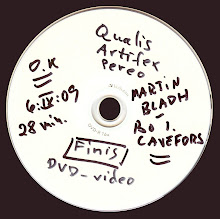
Martin Bladh and Bo I. Cavefors
QUALIS ARTIFEX PEREO - FINIS
Action: Johan Adolphi, Martin Bladh, Bo I. Cavefors and Mikael Oretoft
Photo: Peter Andersson and Lars Bosma
Music: Martin Bladh and Erik Jarl

Produced 12th June 2009 in Norrköping, Sweden
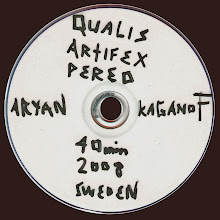
Published as a dvd together with QUALIS ARTIFEX PEREO (Aryan Kaganof) 2009-2010


Copyright©Martin Bladh & Bo I. Cavefors 2009-2010
Copyright Photo©Peter Andersson & Lars Bosma 2010


24.8.09

QUALIS ARTIFEX PEREO - FINIS

+
+
Martin Bladh & Bo I. Cavefors
QUALIS ARTIFEX PEREO - FINIS

Medverkande: Bo, Martin, Johan, Mikael


Ett kvadratiskt eller rektangulärt rum.

Mot väggen projiceras Martin Bladhs videoverk Injury, 21 min, tre delar. Handlingen kretsar kring sexuellt utnyttjade pojkar som i vuxen ålder blivit förövare (actionmotiv: offer/förövare). Filmen har en mycket påträngande stroboskopeffekt, som höjer aktionens intensitet ytterliggare. Endast filmens malande monotona monologer är hörbara (en förvriden androgyn röst). Filmen spelas upp två gånger under aktionen. Aktörernas agerande följer filmens monologer.

Framför väggen sitter Martin naken (endast iförd en suspensoar med intorkade blodfläckar) på en regissörsstol, armar och ben sammanbundna på ryggen. Repet binder även samman Martin med stolen. Repet slås även runt Martins kuk. Blicken fäst vid golvet. Martins hud har pudrats med talkpuder (rent offer/Apollo). Skamsen. Men sneglar under actionens gång på Bos och Johans ageranden.

På golvet framför stolen (rummets mitt) ligger Bo, naken i korsformation. Svart huva över huvudet. Vid hans fötter på en vit trasa med intorkade blodfläckar, ett grishjärta inlindat i bandage, ett rakblad, en livrem, och ett litet metallfat med tändstickor och cigaretter. På vänster respektive höger sida om honom ett njurformat metallfat fyllt med människohår. På golvet ovanför Bos huvud (mellan Martin och Bo) står en tredje metallskål, även den fylld med människohår.

Mikael, naken förutom ett bälte med en bajonett och blå plasthandskar, huden har pudrats med vitt talkpuder - ren bödel/Apollo). Mikael står med ansiktet vänt mot rummets vänstra vägg, händerna på ryggen.

Bo och Johan har före föreställningen rullat sig i grus, kol eller liknande (Dionysos), så att de är smutsiga, otvättade.

Johan, naken, står vid den högra väggen (mitt emot Mikael), runkar, smeker sig.

Publiken står utmed rummets tre väggar, dvs Mikael och Johan står tillsammans/mitt bland publiken.

Efter ca 10 min drar Mikael av Bo huvan och håller sedan huvan i handen. Samtidigt börjar Bo att onanera, liggandes, använder kroppsoljan, smetar in sig, fokus: anus och kuk. Samtidigt onanerar Johan, tänder en cigarett, röker njutningsfullt och tittar på Bo.

Mikael tänder på innehållet i skål 1.

Bo reser sig efter 22 min (filmen har tagit slut och börjar om från början). Mikael går bort till Martin på stolen och drar huvan över hans huvud (motiv: offer-identifikation med bödel). Martin blottar strupen (motiv: offer-identifikation med bödel).

Mikael tänder innehållet i skål 2, och går sedan tillbaka till sin utgångspunkt vid den vänstra väggen.


Johan och Bo smeker och kysser varandra över hela kropparna. Runkar varandra, suger varandra, osv. Johan fimpar aska på Bo. Johan släcker sin cigarett på Martins rygg. Återvänder till Bo och agerar sexuellt häftigare än tidigare.

Mikael tänder på håret i skål 3.

Johans och Bos sexuella aktiviteter blir livligare, hårdare. De piskar varandra med livremmen, sadistisk lek. Bo går fram till Martin och ger honom fem hårda rapp med livremmen. Bo slänger livremmen på golvet. Johans och Bos sexuella lekar blir aggressivare, de brottas (Bacons/Muybridge brottare), de smörjer in varandra med olja. Johan knullar Bo, båda ejakulerar. Samtidigt går Mikael fram till Martin och skär ett djupt snitt i hans högra sida med rakbladet. Mikael skär sönder suspensoaren, river den i bitar, slänger delarna på golvet. Suger in blodet i munnen, spottar ut det på Martins kuk, smetar in det med handen. Mikael reser sig, skär loss Martin från stolen. Bo och Johan ligger kvar, utmattade, kysser varandra.


Filmen slut, Martin sitter kvar i stolen - strupen blottad. Mikael avlägsnar bandaget runt grishjärtat, håller upp det i högerhand, drar upp bajonetten, ställer sig i korsformation. .

Bo och Johan ligger kvar - omslingrade på golvet.


Hjärtat brinner.

Projektion: 5 minuterAcéphale-mannen (André Masoon).

Musik: utdragen orgelton.


Copyright©Martin Bladh och Bo I. Cavefors, 2008, 2009.

23.8.09

QUALIS ARTIFEX PEREO - FINIS


Appendix: INJURY

1
1:1
In spite of everything I was smiling when I was little. I can tell from photos. But inside I felt bad . It’s like I had two personalities. On the outside I was a good little boy, steady, good at school . Inside, I felt different from the others. I was apprehensive.

1:2
I was often in tears because of the fights at home. My mother used to say that boys don’t cry. To punish me she would stand me in front of the mirror, while she humiliated me in front of my brothers and sisters, she would say: “Look at that cry baby, see how you look! You’re not even a man, you’re nothing but a scared cat…” There was no tenderness or love in our house. Not for me anyway. My mother was sounding off all the time. I never could do anything right as far as she was concerned.

1:3
One day we had visitors at home, I had to sleep on the sofa in the living-room and let someone else have my bed. That’s when it all began. I was sleeping on my stomach, in my underwear. Half asleep, I felt someone come up behind me, pull down my shorts, and penetrate my rectum. I was so afraid that i didn’t dare to turn over. I could hear his heavy breathing, feel his breath, but I couldn’t see him. I believe it was my father because I knew how he smelled, how big he was. I had no idea what to do, what to say. I hurt all over. I was bleeding from the rectum. The next day I stayed in bed, I couldn’t stop bawling. For a long time after that, whenever I got nervous, I would mess in my pants. Maybe it was a physical problem because of the dilated rectum, perhaps it was psychological. I don’t know, but I had the problem for years.

1:4
What my brothers asked me to do was disgusting. I don’t know where on earth they got such ideas. One of them urinated in my face. Another time he shat on me. He was laughing, he found it amusing. I was crying and I ran away from them. A bit later my oldest sister asked me to have sex with her. She was laughing at me because I still didn’t have erections. She said I had a small penis. It felt ill at ease. I find it hard being humiliated.

1:5
For a few years, I admit, I didn’t question what was going on, but when I was about twelve or thirteen I often thought about what was happening and wondered about it. I compared myself to others and realised I wasn’t normal. When I might have wanted to talk about it, I figured that nobody else talks about anything, so why should I?

1:6
Around the age of eleven, I started hitch-hiking on the big highway. I was looking for attention, for affection. Anybody would do. Sometimes cars would stop an pick me up. I didn’t dare to say no when they asked me to fellate them. First, they would touch me, checking me out to see how I would react. When they could see that I appeared to be okay with the idea, that I wouldn’t make a fuss, they would pull over and stop further on. They would do what had to be done in the woods or in a field.

1:7
I don’t want to be with anyone, man or woman, who would want sex with me, when someone seems to be interested in me, I imagine it’s just for sex. I would like to meet someone, but I can’t get away from the idea of abuse, the fear of sexuality. I am not used to receiving pleasurable caresses. I fell bad when someone touches me. A person who touches me disgusts me. And sperm, even my own, I find disgusting. I don’t like kissing on the mouth either.

2
2:1
I don’t like my body. Maybe it’s because I haven’t appreciated the sexual relationships I’ve had. I’d like to have a different body, a complete makeover so I can say I’m starting my life over from zero.

2:2
I would have liked to have a girl interested in me, but I didn’t attract girls. I must admit I wasn’t comfortable too with myself. I was full of complexes, fears, and sensitivities. My brothers were making fun of me because I still wasn’t ejaculating at the age of eleven. I was wondering how to go about getting involved with girls.

2:3
Men, they’re always ready for sex, and afterwards it’s like “Don’t know him, never seen him”. If I went about it the same way with a girl as I do with men, she’d think I was a sex maniac. My favourite trick is to wait in the park or in a public toilet until a man comes in. Then, if he hangs around, it he’s looking at me… there are lots of ways to tell if he’s interested… and since I’m quite good looking…

2:4
What excites me is a sense of danger. I get a thrill out of it. Actually, men probably excite me less than the context in which things are happening. Getting it on with a guy, undisturbed, in a bedroom, with a little background music playing, that’s okay for homosexuals. But that doesn’t interest me. What I want is the risk, the fear of being found out, being surprised.

2:5
I like to masturbate. Like to play the exhibitionist, too. I’ve done that since I was a teenager, I’ve been arrested by the police for it. It always happens in a special context. When I’m drunk, on drugs, something inside me wakes up. I stand outside a house, in the garden , in front of peoples windows and show myself off. Then I masturbate, sometimes even ejaculate in front of them. It’s always women, just women. In the beginning I used to leave the windows and curtains open at home and parade about in the nude. I liked the turn-on. Then i went out to do it. I found that even more exciting.

2:6
I put on a tough front. People think I’m hard but I’m just acting a role, like in a drama. I identify to great extent with Jim Morrison of the Doors. I would love to write music and write like him. The essential is that I will have to be myself. But it’s though I no longer have an identity, that I’ll have to glue on one, so to speak. I do have a made-up identity, but it’s only a role I play.

2:7
Ideally, I would like to find myself on my own in a place where everything is beautiful and pure, where everything that happens is agreed upon. There at least I could be with someone without risk. I am bisexual, perhaps, but I don’t want sex.

3
3:1
A homosexual picked me up and took me in. After a few days, he asked me to have sex with him. I didn’t say no. Having sex had become a habit for me. I no longer even asked myself if I preferred males or females. I don’t consider myself a homosexual: in my fantasy life I prefer women and children.

3:2
I must admit I’ve had fantasies about younger boys also. At a certain point I had a dream: I was abusing a young fellow the way I was abused. That’s really not my thing. I reacted badly. It was as though I’d been hit on the head with a sledgehammer. I thought of killing myself. I cut my veins. But I stopped in time. This went on for about eight or nine months. I said to myself: If I’m capable of doing it in a dream I could do it awake. But I don’t want to be involved with young boys. I’m in therapy for that. I try not to think of the past. It’s like putting on a suit of armour. I’ve had other similar dreams recently, with girls in the dreams too. I wake up and feel excited. But now, instead of panicking, I try to make connections. I ask myself what happened the day before to make me think of that. I keep a journal to help me understand, to make connections between it all.

3:3
When I had homosexual fantasies I couldn’t control, I had the idea of hiring a male prostitute. At night, I would cruise the streets where they hang out. A prostitute was abetter solution, less distressing for me. The prostitute was okay with it and after, for me it was out of sight, out of mind. I wasn’t accountable to anybody.

3:4
To me they’re all sluts, like my mother. When I make love, you know, I’m a very gentle fellow. With certain women some vengeance will surface, but not with all. Most of the women I made love with were not aware of what was going on inside me.

3:5
As an adolescent, began to cut me myself, to carve into my arm because I was mad at myself. I wasn’t unable to express my violence except against myself. I had other problems. I had begun to masturbate more or less anywhere, openly, in the classroom, on the bus. It was like an experiment for me. I was putting objects into my rectum too. That way, I wasn’t hurting anyone else. I find it difficult to accept my sexuality.

3:6
The first time a masturbated on a child was when I was babysitting the daughter of one of my brothers. She must have been about two or three. I took off her diaper and rubbed my penis against her private parts. I didn’t want to penetrate her, just to feel her next to me. I did it again a few more times before I began to be afraid of what I might do. I stopped. I realised I wasn’t normal. To put it out of my mind I used to drink. I was taking pills, taking drugs. Perhaps it was the softness of the baby that attracted me to her. Still today, with women, I never feel completely satisfied sexually. It is children who excite me the most, although I don’t want to touch them, anymore.

3:7
I have violent thoughts about buying weapons and getting some revenge. I know there’s something missing, something dead inside me that I’ll never get back. I rail against this. But you know, when I was little, I was a romantic… wrote poetry for my friends’ girlfriends. I would have turned out quite different if these things hadn’t happened to me.


Copyright©Martin Bladh&Bo I. Cavefors, 2008.

8.2.09

dionysos andronis : qualis artifex pereo


'
'
dionysos andronis

QUALIS ARTIFEX PEREO (2008)

In filming this Swedish actionist performance, Aryan Kaganof returns once again to the world of body art, a favourite haunt of his for a very long time. His old classic films of Ron Athey’s extreme performances, which he shot in the 1990s, are proof of his obsession with this major discipline of contemporary art.

The performance by Bo Cavefors, a master of Swedish body art, is filmed in a very poetic way by Kaganof, and took place in June 2008 in Malmo. It’s entitled "Action Number 43" and is in the same vein as his earlier performances. Bo Cavefors is lying on the ground in the beginning of the film. A zoom out from his face is the starting point for this action. The film is devised as a triptych, like one of his earlier performances which took place in 2007 in Stockholm and was called "Three Studies for a Crucifixion" after Francis Bacon’s work of the same name.

During the opening sequence of the film "Qualis Artifex Pereo", we see three actors around Cavefors, the central actor. Two women and a man watch him in silence as he masturbates and slowly readies himself for the climax...

CONTINUE!!!

1.12.08

"Christer" - Darkside om Qualis... på Signal


no no
no no no no
no no no no
no no there's no limit.
(ur 2 Unlimiteds, No Limit)
+
Galleri Signal - Center för samtidskonst i Malmö visas just nu en grupputställning omfattande 87 konstnärers verk i en lokal om 70 kvadratmeter. Titeln på utställningen är hämtad från refrängen till den nederländska gruppen 2 Unlimiteds energirika eurodiscoplåga No Limit. Trångt och svettigt men trivsamt med väggar, golv och tak bågnande av rykande dagsaktuella inlägg i ett oavbrutet pågående samtal om vad som är angeläget för oss i nuet. Det är konst i alla stilar och former, och utställningsrummet har utnyttjats till bristningsgränsen för denna salongsvisning, lite ovanligt för samtida icke-kommersiella gallerier. Tanken bakom utställningen är att den skall vara en lokal provkarta och visa på den konstnärliga aktiviteten i staden Malmö under föregående och innevarande år. Energitillskottet från refrängen kan behövas, för Signal är nedläggningshotat, men No Limit visar att Malmö sjuder av konstnärlig vitalitet. För mer information, se http://www.signalsignal.org/.
+
Bland alla de andra verken visar Bo Cavefors och Martin Bladh filmen Qualis artifex pereo från 2008, en dvd filmad av Aryan Kaganof. Det latinska citatet skall ha varit kejsar Neros avskedsord vid självmordet år 68 och betyder "Vilken konstnär förlorar icke världen i mig". Filmen Qualis artifex pereo visas non stop. På förfrågan kan man även få se filmen Tre studier för en korsfästelse, ett passionsdrama i tre akter tillägnat Francis Bacon från 2007, inspelad på scenen Fylkingen i Stockholm, dvd och cd utgiven av Firework Edition Video, Stockholm 2007, se vidare www.fireworkeditionrecords.com. Enligt de uppgifter jag inhämtat från galleriet och privat finns Qualis artifex pereo ej utgiven som film och kommer ej heller att tillhandahållas allmänheten mer än som här på Signals utställning. Dramatexten till Tre studier för en korsfästelse finns utgiven i bokform av det utmärkta förlaget h:ström (Hammarströms förlag), se http://www.hstrom.nu/.
+
Iscensättningen utgår från Bo Cavefors egna texter i samarbete med Martin Bladh. När man läser skrift finns alltid ett raster mellan läsaren och det som beskrivs, ett raster som distanserar. Här gestaltar Cavefors tillsammans med de andra skådespelarna vad som finns nedtecknat på papper. Det gör chockeffekten väldigt påtaglig. Man kan känna sig äcklad. Man kan känna sig provocerad. Många ser säkert ett rent effektsökeri i det hela. Nedbrytandet av normer och tabun är tydligt framträdande. Starkt är det i alla fall och på det sättet god konst genom att ruska om den ljumma själen och det lata sinnet. Den här typen av scener ser vi annars bara på klubbar och fester inom vår subkultur, givetvis även privat och i våra sängkammare och lekrum, men inte på teaterscener eller som här på film och på en konstutställning.
+
Om vår teater stinker, är det för att alla andra pjäser luktar gott. (Jean Genet)

"Christer"
Darkside, 7 oktober 2008.

7.8.08

Bladh & Cavefors MANIFEST

THE NEW THEATRE OF CRUELTY has a constant discourse with the universal theme violence-sex-death-cruelty, and THEATRE DECADENCE expose the possibilities of agere contra as an answer of the norm-terrorism. agere contra: break off the foundationalism of uniformity and release the traditions from the ancient Greeks, from Romans of the Roman Empire, from the equestrians of Middle Ages and from the decadency of to-day. Non-norms are, that’s our belief, the normal-reality and the norms are the real morbid, hokey, obtruded, the non-worthy. Howe’er, our actions are no and never outcries against the norm-society and it’s seers; we waive face-downs. We have no political declarations. We manifest how the abasement can be handled when we convert it to enjoyment and sexual absolutism and exhibitionism and a strict acceptation of it’s most profounded consequences, sperm, blood, whips. + + + Our first action/performance, related to Francis Bacon, Three Studies for a crucifixion, is followed by actions about the Roman paederast Heliogabalus and Gilles de Rais, the mediavel-boylover, the virtiuoso and aesthetican. An eon of twothousand years shall be visualized: how rites and Eucharistic adoration are transfigured in the flight of time, but still are ageless: Dionysiac indulgence, body and sex, distress, the surrender, blood and hangmen. + + + Ernst Jünger mention the “anark”, the man who smash the power in ignoring it, an individual resigning the normal. That’s our position. As Jean Genet said: “If our theatre stink it’s because all other plays stink good”. + + + Martin Bladh / Bo I. Cavefors

african noise foundation

african noise foundation
in association with
grymhetens teater dekadens
present
"qualis artifex pereo"
("oh what an artist the world loses in me"
emperor nero’s dying words upon committing suicide)
+
an acéphale performance by
bo i. cavefors,
johanna rosenqvist,
martin bladh,
& s.o.
+
text by georges bataille and martin bladh
+
music composed by martin bladh
+
sound engineer mikael oretoft
+
film aryan kaganof
+
photoedition bo i. cavefors
+
+
+
(40min, HDV, Sweden, june 2008)

QUALIS ARTIFEX PEREO

++
+
+
Georges BATAILLE/BLADH, Martin
+

+
+
När mitt ansikte fylls med blod, blir det rött och obscent. Det förråder samtidigt, under förvridna reflexer en blodig erektion och en oumbärlig törst för oanständighet och kriminell sedeslöshet.

+
+
+
Av denna orsak avskräcks jag inte att hävda att mitt ansikte är skandalöst och att min passion endast kan yttra sig genom JESUVET.
+

+
+
Det världsliga klotet är täckt med vulkaner, som tjänar som dess anus. Trots att detta klot inte äter någonting, slungar det ofta ut sina tarmars innehåll.
+

+
+
Innehållet som skjuts ut med oväsen och faller tillbaka, strömmar ned längs Jesuvets sidor, sprider död och förintelse överallt.
+

+
+
Djurlivet kommer i sin fullständighet ur havens rörelser, och inifrån kropparna, fortsätter livet att komma av saltvatten.

+

+
+
Havet, har spelat rollen som det kvinnliga organet som fuktas under penis retning.
+

+
+
Havet runkar av kontinuerligt.
+

+
+
Solida element, som inhyses och frodas i vattnet väcks till liv av erotisk rörelse; slungas ut i form av flygande fisk.

+

+
+
Erektionen och solen chockerar på samma vis som ett kadaver och källarens mörker.
+

+
+
Vegetationen är enhetligt riktad mot solen; människor, erigerade likt träd, skyller trots sin uppenbara olikhet med djuren, även de av nödvändighet sina ögon.
+

+
+
Det mänskliga ögat tolererar varken sol, coitus, kadaver eller det obskyra, men reaktionen är av en annorlunda natur.
+

+
+
Tallkottögat, som särskiljer sig från det horisontala systemets normala okulära syn, uppenbarar sig således i en slags tårfylld nimbus, likt ett träds öga eller, möjligen, ett mänskligt träd. Samtidigt är detta okulära träd inget mer än en väldig rosa penis, som under solens berusning vittnar om eller påkallar ett vämjeligt illamående, en kväljande ångestladdad svindel.

+

+
+
Enligt denna naturens omgestaltning, under vilken synen i sig, attraherad av det vämjeliga, dras ut och slits sönder av solflammorna som den stirrat in i, slutar erektionen sin smärtsamma omvälvning på jordytan och i en uppstötning av smaklöst blod, förvandlas den till ett svindlande fall genom den världsliga rymden, åtföljt av ett fruktansvärt skri.
+

+
+
Att vara medveten om världen och lemmarnas organiska puls.
Ständigt närvarande i köttet: blod, märg, slem.
Buken pressar mot marken, pryglar den nakna jorden.
Rygg och måltavla ständigt utelämnad åt ers nåd: vråk, hyena.
+

+
+
MODERGAM
MODERSCHAKAL

+

+
+
Din grymhet gödde mig: din livsfrukt.
Det som står till svars inför mig; mitt kött och livsgärningar.
Ditt avträde.
Din livsfrukt.
De fria lemmarnas krig;
ett organens anarki, vrålet efter vedergällning och utlösning
.
+

+
+
MODERGAM
MODERSCHAKAL
+

+
+
Jag håller eggarna
Jag pekar dem mot dig
Jag för dem tillbaka upp genom dig
Jag möter motståndet inuti dig,
tillbaka in genom grymheten;
den farsot som gödde mig.
+

+
+
Solen, benägen på himlavalvets botten likt ett kadaver i avgrunden, besvarar detta omänskliga skri med förruttnelsens spöklika attraktion. Den överväldigande naturen bryter sina bojor och kollapsar inför det obegränsade tomrummet. En avskuren penis, mjuk och blodig, är substitut för tingens invanda åtgärder. Inom dess ramar, där smärtfyllda käftar fortfarande biter, var, spott, och enorma flugors larvägg frodas: exkrementalt likt ögat som målats på botten av en vas, lånar Solen sin strålglans i döden, begraver existensen i den stinkande natten.

+

+
+
Det världsliga klotets storhet kan liknas vid en kal skalle, från vars mitt det vulkaniska ögats påle öppnas upp mot himlen. Det breder ut sitt katastrofala landskap ned i det håriga veckade köttet, och håret som formar dess buske är översvämmat med tårar. Men förfallets problematik, främmande som självaste döden, har inte sitt ursprung i en ordinär hjärna: tunga inälvor pressar i ensamhet detta nakna kött, lika laddat med obscenitet som en bakdel – lika satanisk som den likaså nakna stjärten som en ung besvärjerska reser mot den svarta himlen i samma ögonblick som hennes fundament öppnas, för att mottaga den flammande facklan.

+

+
+
Kärleksvrålet som slits ur denna komiska krater är en febrig snyftning, en alarmerande åskknall.
+

+
+
Solens exkrementala öga har alltså befriat sig från dessa vulkaniska inälvor, och smärtan hos en man som sliter ut sina egna ögon med fingrarna är ej mer absurd än solens anala moderskap.
+

+
+
Kärlek, skriker då ur min strupe; jag är Jesuvet, den smutsiga parodin på den heta och bländande solen. Jag vill få strupen avskuren medan jag skändar flickan till vem jag fått tillfälle att säga: du är natten.

+

+
+
Solen älskar uteslutande natten och riktar sitt flödande våld, sitt skändliga skaft, mot jorden, men finner sig inkapabel att nå varken blicken eller natten, även då nattens världslighet kontinuerligt vidgar huvudet mot den skändliga solära strålningen.
+

+
+
Solar annulus är hennes kropps intakta anus vid 18årsålder mot vilket inget, undantagsvis solen är tillräckligt bländande, även då anus är natten.
+

+
+
Jag skiter ned mig i solen imorgon, öppen – naken med skuld.
Sedan impotens, fortsatt förlust – triumf eller förtvivlan?
Är detta vad allt handlar om;
Negation? Inversion? Fascination? Terror? Njutning eller tortyr?
En ekonomisk skuld.
Profit/förlust,
spendera/inkassera,
förlösning/utlösning.
Varför blir dessa fotografier och videoband min spegel?
Varför denna vackra förpackning; intakta vägg av kött och ord?
Brustna ådror, O-kompletta meningar synbara genom huden.
Så vad får dessa ord att bli sanna?
Så vad är egentligen en upplevelse?
Ett altare, det olycksbådande verk som rests i mitt badrum?
Ett gömt lönnfack bakom bokhyllan i mitt vardagsrum?
Konturerna av mitt ansikte, lår händer och skrev?
Vid brantens rand…förbrännas, upplösas på samma sätt som dessa fotografier framkallades.
Vid brantens rand…suddas ut, leva dessa ord; ta dem på mig, bokstavligen.
Vad jag gör blir slutgiltigt; en outtröttlig process; en privat implosion av överflödiga ord, av ständigt upprepade bilder.

+

+
+
Nära en rund grop, nyligen grävd i den frodiga vegetationen, kämpar en långarmad aphona med tre män, som binder henne med långa rep: hennes ansikte, lika idiotiskt som det är gement, släpper ut fruktansvärda skrik av fasa, skrik som besvaras av andra tjut från mindre apor i det höga grenverket. Sammanbunden som en kyckling – med benen bakvikta mot kroppen - binder de tre männen henne runt en påle som rests i gropens mitt.

+

+
+
Fastbunden på detta vis, sväljer hennes monstruösa ylande mun jorden, medan den andra sidan, hennes enorma vrålande rosa analöppning stirrar upp mot himlavalvet likt en blomma: endast delen vars obscenitet överväldigar är synlig över gropens kant.
+

+
+
I den absurda himlens tomrum, spydde solen som ett sjukt fyllo över munnar fyllda med kosmiska skrik...Och så förenar sig hettan och omtöcknaden i en allians – lika överskridande som tortyr: som en avskuren näsa, som en utsliten tunga – de firar ett bröllop (firade med rakbladets egg mot näpna, oförskämda små stjärtar), denna lilla kopulering mellan det stinkande hålet och solen...
+

+
+
Jorden, skakad i sina grundvallar, besvarade naturens tvivelaktiga kolik – utlöste, i skogarnas klibbiga halvskugga, genom oräkneliga köttblommor – med den högljudda glädjen av inälvor, med kräkningar från otroliga vulkaner.
+

+
+
På samma vis som ett plötsligt skratt utlöser andra, eller en gäspning utlöser gäspningar bland en folkmassa, har en burlesk exkremental kramp släppts lös, en krampaktig eld, under en svart himmel härjad av åska. I detta underland, bryter en vind, tyngd med blodig rök, då och då ned enorma glödande träd, medan floder av pryglande rödglödgande lava strömmar fram överallt, som från himlen. Med köttet på halster, med munnar förvridna i infantila skrin, flyr de stora aporna, offren, undan denna vansinnes tortyr.
Flera av dem fälldes och klämdes skrikande fast på rygg eller mage, under brinnande trädstammar; de fattade snart eld och brann som fnöske.

+

+
+
Emellanåt, hände det, att några enstaka som hamnat på en trädfri strand, räddades undan lågorna, skyddade från röken av en motvind: de var dock inte mycket mer än utmattade sår, oformliga silhuetter, halvförtärda av elden, som tog sig upp eller låg kvar och gnydde på marken, ragglandes i fruktansvärda plågor. En kaskad av röd lava – mardrömslikt bländande – en apokalyptisk lava som verkade blödas ut ur deras egna anus (precis som deras egna håriga kroppar ursprungligen hade visat, och enligt sadistiskt manér stuckit fram sina vidriga anus – som för att skända och förolämpa existensen). Dessa olyckliga varelser blev i likhet med kvinnans barnfödande livmoder, någonting fruktansvärt...
+

+
+
Likt rovdjur sliter ni sönder min oskyddade muskelvävnad,
mal den mellan rakbladständer,
suger näring ur märg och blod,
för att slutligen svälja ner mig i ert uttänjda innanmäte.
+

+
+
Öppna ert universum av röda implosioner,
maligna undervattenstumörer,
låt dem svälla och föröka sig i den fertila myllan.
Jag er outvecklade livsfrukt,
Jag ert stympade krymplingsväsen,
Jag som delvis undkommit urmoderns käftar,
+

+
+
låt mig sakta upplösas i er gigantiska apparat,
låt mig smekas av tarmtrådar och enzymer
på väg mot slutstationen
på väg mot undergången
+

+
+
låt den yttre världsbilden avlägsnas
länken: den evigt uppstående,
reser sig ur sitt predestinerade stålbad
Svärdet, Lemmen, Armen,
jag för er tillbaka in i skapelsens svällande kötträdgårdar.
+

+
+
Ögat som på toppen av huvudet, öppnar sig mot den glödande solen för att skåda dess ödesdigra ensamhet, är inte sprunget ur förnuftet, det är en omedelbar existens, som öppnar och bländar sig självt likt en eldsvåda, likt en feber som äter varat, eller mer precist, huvudet. Det fungerar som ett brinnande hus; där huvudet, istället för att låsa in livet som pengar i ett kassaskåp, spenderar dem urskillningslöst, för att vid slutet av den erotiska metamorfosen, ha tagit emot den elektriska kraftens udd. Detta enorma brinnande huvud är bilden och det motsägelsefulla ljuset av utgiftens föreställning, omsorgsfullt utarbetat enligt den metodiska analysens basis bortom den fortfarande tomma förbrukningens föreställning.

+

+
+
Ursprungligen identifierades myten inte enbart med livet utan med dess avsaknad – med förfall och död. Det börjar med varat som bar den inom sig, den är inte alls en extern avkomma, utan den manifestering som det flytande varat intar i hans egen gestalt; med denna extatiska gåva gör han sig själv till ett obscent naket offer – inte ett offer inför en obskyr och immateriell kraft, utan inför skrattet från vrålande horor.
+

+
+
Existensen påminner inte längre om en detaljerad linje som leder från en punkt till nästa, utan istället om en sjuklig glöd, en bestående orgasm.
+

+
+
All jordens plantor reser sig mot himlen, och slungar kontinuerligt ut myriader glänsade spottstrålar mot solen i form av blommor, och enbart en obscen Van Gogh, omgiven av galningar kan slunga sina ögons falliska lorska mot samma sol. De andra människovarelserna släppar runt som stora erigerade impotenta fallosar, med ögonen fastlåsta på den sövande omgivningen.

+

+
+
Det är nödvändigt att bryta upp sig själv i bitar och känna vansinnet slingra sig i kroppen; samtidigt måste man bli fetischist på gränsen till slav, en ögonfetischist, en fetisch för skinkor och fötter, allt i ett, för att i sig själv kunna återväcka vad som olyckligtvis aborterades i den ursprugliga människokroppens konstitution.
+

+
+
Anus kala höjd har blivit centrat, svärtat av buskage, på den trånga ravinen som klyver skinkorna.

+

+
+
Den spöklika manifesteringen av denna teckenförändring representeras av en främmande mänsklig nakenhet – nu obscen – som är substitut för den håriga djurkroppen, och speciellt av pubishåret som uppstår på exakt samma ställe som apan var hårlös; omgiven av en dödsgloria, en varelse blek och för stor reser sig, en varelse som, under en sjuk sol, inte är någonting annat än det himmelska ögat den saknar.
+

+
+
Som universums medelpunkt kommer mitt kött att förtäras av er hunger:
fäder, mödrar, söner, döttrar.
Jag är obegränsad.
Jag finns till för er alla.
Svarta och livlösa ser mina svarta dockögon ner på er från den helgade platsen ovanför altartavlan.
+

+
+
Mitt kall innebörden av mina gärningar och dagliga iscensättningar.
+

+
+
Ett kött av oändliga möjligheter och uttrycksformer.
Hur jag fann mig själv – Länken: Logos.
Hur ni hörde kallet, tog mig i er famn.
Bar mig till altaret och reste mitt podium.
Allt är nu väldokumenterad historia.
+
+

+
Copyright©Martin Bladh 2008.

+
+
+
+
+
+

1.


2.


3.


4.


5.


6.


7.


8.


9.


10.


11.


12.


13.


14.


15.


16.


17.


18.


19.


20.


21.


22.

22

23.


24.


25.


26.


27.


28.


29.


July 11, 2008

“QUALIS ARTIFEX PEREO” (2008) – un film de Aryan Kaganof + + + + + Ayant filmé cette performance actionniste suédoise, Aryan Kaganof récidive encore une fois dans le domaine de l’art corporel, qui est son domaine de prédilection depuis très longtemps. Ses anciens films classiques des performances jusqu’au-boutistes de Ron Athey, filmés dans les années 90 également par lui, ce sont des preuves de son obsession par cette discipline importante de l’art contemporain. La performance filmée d’une manière très poétique par Kaganof est celle de Bo Cavefors, un père de l’art corporel suédois, qui a eu lieu en juin 2008 à Malmo. Elle s’intitule «Action numéro 43 » et elle est dans l’esprit de ses actions précédentes. Bo Cavefors est allongé par terre au début du film. Un zoom out de son visage est le point de départ de l’action. Le film est conçu comme un triptyque, à la manière d’une autre performance du même artiste. Elle a eu lieu en 2007 à Stockholm et elle était intitulée «Trois études sur une crucifixion», d’après la même œuvre de Francis Bacon. + + + + + Pendant la première séquence du film «Qualis Artifex Pereo» on voit trois actants autour de Cavefors, qui est l’actant central. Deux femmes et un homme l’observent silencieusement en train de se masturber et de se préparer lentement pour le point culminant de la troisième séquence. Pendant que Johanna Rosenqvist récite en suédois les vers magiques de «L’Anus Solaire» de Georges Bataille, Cavefors se caresse et commence des fellations avec l’homme Martin Bladh. Des mouvements voyeuristes de la caméra sur les parties de son corps et des autres actants deviennent insistants et excitants. L’extrait récité a été écrit en 1931 et ça commence ainsi :«Quand j’ai le visage injecté de sang, il devient rouge et obscène.Il trahit en même temps, par des réflexes morbides, l’érection sanglante et une soif exigeante d’impudeur et de débauche criminelle. + + + + + Ainsi je ne crains pas d’affirmer que mon visage est un scandale et que mes passions ne sont exprimées que par le Jésuve.Le globe terrestre est couvert de volcans qui lui servent d’anus.Bien que ce globe ne mange rien, il rejette parfois au-dehors le contenu de ses entrailles. + + + + + Ce contenu jaillit avec fracas et retombe en ruisselant sur les pentes du Jésuve, répandant partout la mort et le terreur» (op.cit, repris dans «Œuvres Complètes » éditions Gallimard, Paris, 1970, page 85). + + + + + Cette première séquence de préparation fait 25 minutes. Les textes de Martin Bladh suivent celui de Bataille, toujours récités par Rosenqvist. Tout au long du film il y a une musique discrète composée par l’actant Martin Bladh, le même compositeur stable des performances anciennes de Cavefors. A noter aussi que c’est le même Bladh le traducteur en suédois des extraits de Bataille. + + + + + La deuxième séquence fait 5 minutes et on y voit Cavefors et Rosenqvist en train de préparer leur partition au bureau, habillés comme tous les jours. La troisième serait, d’une certaine façon, le point culminant du plaisir puisque pendant cette partie du film la deuxième femme introduit ses talons dans le cul de Cavefors pendant que la musique devient plus aigue et monotone. 40 minutes est la durée totale de ce film – triptyque extraordinaire. + + + + + Le titre latin signifie “quel artiste meurt ” et ce sont les derniers mots de l’empéreur Néron avant de se suicider. Avec ce choix de titre, Kaganof aimerait nous rappeler que toutes les créations artistiques importantes se basent sur la passion folle, celle qui conduit à la mort. + + + + + dionysos andronis


+
+
+